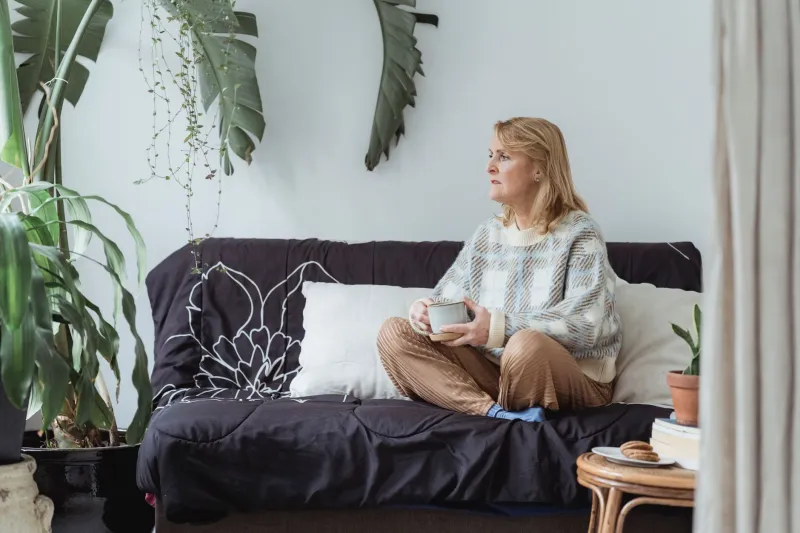
When a Beautiful Home Isn't Enough: The Hard Truth About What Cozy Can and Can't Fix

The Candle Is Lit. So Why Do You Still Feel This Way?
You rearranged the throw pillows. You finally got the warm-toned lamp you've been eyeing for months. The diffuser is going, the playlist is perfect, and the apartment looks like something out of a lifestyle spread. And yet — there it is. That low, persistent hum of something not quite right.
If you've ever done everything "right" in terms of creating a cozy home and still felt hollow, you're not alone. And you're not broken. You're just running into the limits of what a beautiful space can actually do for a person.
That's not a knock on cozy living. Creating a warm, intentional home environment is genuinely good for your mental state. The research backs it up — sensory comfort, soft lighting, and familiar surroundings all contribute to reduced stress and a greater sense of safety. But there's a difference between a space that supports your wellbeing and a space you're using to replace it.
The Very Human Urge to Redecorate When Things Get Hard
Here's something most home and lifestyle content won't tell you: the impulse to fix your space often spikes when something else in your life feels unfixable.
Job feels meaningless? Time to reorganize the bookshelf. Friendship group drifting apart? Maybe a new sectional would help. Feeling that creeping, unnamed sadness that doesn't have an obvious source? Let's repaint the bedroom.
This isn't a character flaw — it's actually a pretty understandable psychological move. Your home is something you can control. You can make it better, visibly and relatively quickly. That sense of agency feels good, especially when other parts of life feel murky or stalled. The problem is that the relief is temporary, and eventually the room runs out of things to rearrange.
Psychologists sometimes call this "displacement activity" — channeling anxiety or avoidance into something productive-looking but ultimately beside the point. When your nesting instinct kicks into overdrive, it's worth pausing and asking: What am I actually trying to feel right now?
Loneliness Doesn't Care How Nice Your Throw Blanket Is
One of the most common — and least talked about — comfort traps is using a cozy home as a substitute for human connection. This is especially easy to fall into in a culture that's increasingly enthusiastic about solo rituals, "introvert sanctuaries," and the art of staying in.
There's real value in solitude. Recharging at home is healthy and necessary. But if your beautifully curated space has quietly become the reason you don't have to reach out, show up, or be seen — that's worth examining.
Loneliness is one of the most significant health risks facing Americans right now. The U.S. Surgeon General issued an advisory on it in 2023, calling it an epidemic. And loneliness doesn't always look like sitting alone in an empty room. Sometimes it looks like a perfectly appointed apartment where someone spends most evenings alone, feeling vaguely okay but not quite full.
A cozy home can make solitude more comfortable. It cannot make isolation less damaging.
Burnout and the Renovation Spiral
Burnout is another area where home improvement projects can become a sneaky stand-in for actual recovery. When you're depleted — really depleted, not just tired — the idea of transforming your space can feel like taking action. And it is action, technically. But burnout isn't fixed by a new bedroom layout. It's fixed by rest, by boundary-setting, by addressing the source of the drain.
Spending a burned-out weekend deep in a home project might feel productive. It might even feel restorative in the moment. But if you're using renovation energy to avoid confronting why you're so exhausted in the first place, you're going to cycle back to the same wall pretty quickly — just with better lighting.
The question to ask yourself: Is this project energizing me, or is it just keeping me busy enough not to feel bad? Those are very different things.
How to Tell the Difference Between Restoration and Distraction
None of this means you should stop investing in your home or feel guilty about loving a good cozy evening in. The goal isn't to strip away the pleasure of a warm, intentional space — it's to make sure that space is actually serving you, rather than covering for something that needs more direct attention.
A few honest questions worth sitting with:
Does your home feel like a place you retreat to, or a place you retreat from everything else? There's a version of home comfort that's genuinely restorative — you go out, you live your life, you come home to recharge. And there's a version where home has become the only place you feel safe, which is a different thing entirely.
Are your home projects solving a problem, or postponing a feeling? Buying a new rug because your old one is worn out is just practical. Buying a new rug at 11pm because you had a hard conversation with a friend and need to feel in control of something — that's worth noticing.
Would you feel okay if your home stayed exactly as it is for the next six months? If the idea of that creates real anxiety, it might be worth exploring what the ongoing improvement project is doing for you emotionally, beyond the aesthetic.
Is the comfort you're creating something you share, or something you hide in? A cozy home that's a backdrop for connection, rest, and genuine renewal is a wonderful thing. A cozy home that's become a bunker against the world is a lonelier place than it looks.
Your Space Can Support the Work, But It Can't Do It For You
Here's the thing — a thoughtfully designed, genuinely comfortable home can support healing, rest, and emotional recovery. Soft spaces matter. Sensory comfort matters. Having a place that feels like yours matters. None of that is up for debate.
But the space is the container, not the content. It can hold the work. It can make the work more comfortable. It can be the place where you have the hard conversation, cry the necessary cry, or finally sit still long enough to hear what you actually need.
What it can't do is be the work. It can't replace the therapist appointment, the honest conversation with your partner, the career pivot you've been avoiding, or the slow and unglamorous process of rebuilding after something hard.
If your home feels like a sanctuary, that's genuinely lovely. If it's starting to feel like the only place you're okay — that's the real thing to get cozy with.