Why Minimalism Might Be Making Your Home Feel Worse, Not Better
Let's be honest: minimalism looked incredible on Pinterest. Those airy, sun-drenched rooms with their crisp white walls, a single trailing plant, and approximately four pieces of furniture arranged just so — they felt like a promise. Clear the clutter, clear your mind. Own less, feel more.
So a lot of us tried it. We donated boxes of stuff, swapped out warm-toned rugs for bare hardwood, and said goodbye to the shelves of books and collected trinkets that had accumulated over years of living. And then we sat in our newly sparse living rooms and waited to feel serene.
For many people, that serenity never quite arrived.
Instead, something felt off. Maybe a little cold. A little hollow. Like staying in a hotel room that's been cleaned but never really lived in. If that sounds familiar, you're not alone — and you're not doing minimalism wrong. You might just be discovering what designers and psychologists have quietly known for a while: when it comes to comfort, less is not always more.
The Sensory Case Against Bare Spaces
Human beings are sensory creatures. Our nervous systems are constantly scanning our environments, picking up on texture, color, smell, sound, and visual complexity. This isn't a flaw — it's how we're wired. And for most of human history, the spaces we lived in reflected that wiring. Homes were layered, textured, and filled with objects that carried meaning.
Minimalism, in its most rigid form, strips away a lot of that sensory input. And while that can feel temporarily refreshing — the way a deep clean of your kitchen makes you feel like you have your life together for about 48 hours — it doesn't necessarily translate into lasting comfort.
Research in environmental psychology consistently shows that people feel more at ease in spaces with moderate visual complexity. Rooms that are completely bare register to the brain almost the same way empty spaces in nature do: as potentially unsafe, lacking in resources, or simply uninviting. Your nervous system doesn't see a minimalist living room and think peace. Sometimes it just sees nothing here.
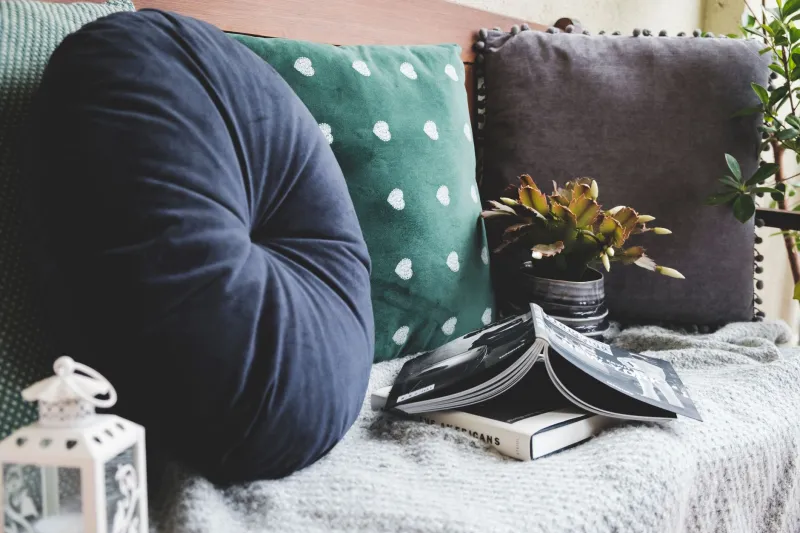
Textures, in particular, do a lot of heavy lifting when it comes to comfort. A chunky knit throw draped over a couch, a woven basket on the floor, a worn wooden coffee table — these things give your eyes and your hands somewhere to land. They signal warmth and habitation in a way that a sleek, empty surface simply can't.
Stuff Isn't the Enemy — Meaningless Stuff Is
Here's where minimalism gets the diagnosis partially right but the prescription wrong. The problem in most cluttered homes isn't that there's too much. It's that a lot of what's there has no particular meaning or purpose. It's the junk drawer that's never been sorted, the decorative objects you bought on a whim and don't actually love, the furniture that doesn't fit the room but you haven't gotten around to replacing.
That kind of accumulation does create a kind of low-grade stress. It's visual noise without emotional signal.
But the solution isn't to clear everything out. It's to get intentional about what stays.
Think about the objects in your home that actually make you feel something when you look at them. The framed photo from a road trip you took with your best friend. The mug your kid painted at one of those pottery studios. The lamp you found at a flea market that somehow perfectly fits the corner of your bedroom. These aren't clutter. These are anchors. They connect you to your own history, your relationships, the parts of your life that feel most like you.
Minimalism, taken too far, asks you to let go of those anchors in the name of aesthetic cleanliness. And for a lot of people, that trade-off doesn't feel like freedom. It feels like loss.
The Hygge Lesson We Keep Ignoring
The Danish concept of hygge — that untranslatable feeling of warmth, togetherness, and contented comfort — has been talked about so much in American lifestyle media that it's practically a cliché at this point. But it keeps coming up for a reason: it describes something real that a lot of us are chasing.
And here's what's interesting about hygge spaces. They are almost never minimalist. They're layered. Candles on the table, soft lighting, throws piled on the couch, a shelf of well-loved books, maybe a bowl of something warm on the coffee table. They're full — but not chaotic. There's a difference.
The distinction is curation versus deprivation. Hygge spaces are intentionally assembled to maximize sensory comfort. Every element is doing something: softening the light, adding warmth underfoot, inviting you to slow down and settle in. Nothing is there by accident, but nothing has been ruthlessly eliminated either.
That's the framework worth stealing.
Building a Cozy Space Without Going Full Maximalist
If you're recovering from a minimalism experiment that left you cold — literally and figuratively — the good news is you don't have to swing to the opposite extreme. You're not choosing between a bare white box and an episode of a hoarding documentary. There's a very livable, very comfortable middle ground.
A few places to start:
Layer your textiles. This is the single fastest way to make a room feel warmer. A rug underfoot, a throw on the couch, curtains instead of bare windows — fabric absorbs sound and adds visual softness that hard surfaces can't replicate. Mix textures: something smooth, something nubby, something that invites you to touch it.
Bring in warm light. Overhead lighting is the enemy of coziness. Swap in lamps, add some candles or candle-style LED lights, and let your rooms exist in pools of warm glow rather than uniform brightness. Your whole house will feel more inviting after dark.
Keep what you love, lose what you don't. Go through your shelves and surfaces not asking does this spark joy (sorry, Marie) but does this mean something to me? Objects with personal history earn their place. Objects you bought because they seemed like they should be there probably don't.
Don't be afraid of books, plants, and collections. These are the things that make a home look inhabited rather than staged. A bookshelf full of well-read paperbacks, a cluster of houseplants in a sunny corner, a small collection of ceramics or vintage finds — these add life and personality without tipping into chaos.
Give clutter a home, not the boot. Some things just need to be accessible: remote controls, charging cables, the random assortment of stuff that accumulates on counters. Instead of eliminating these things, find attractive ways to contain them. A pretty tray on the coffee table, a basket by the door. The goal is organized warmth, not sterile emptiness.
Comfort Is Personal — And That's the Whole Point
At the end of the day, the most important thing your home can do is make you feel comfortable — not a design blogger, not a lifestyle influencer, not the version of yourself you imagine might exist if you finally got your act together and owned fewer things.
Minimalism works beautifully for some people. If clean lines and open space genuinely make you feel calm and at peace, lean into that. But if you've been trying to force yourself into a sparse aesthetic that leaves you feeling vaguely unsettled in your own living room, it might be time to give yourself permission to stop.
Cozy isn't a design failure. It's a design goal. And sometimes the path there runs directly through the things you almost donated.